

Commercial roofs in Fillmore, NY work hard. Snow load, freeze-thaw cycles, and spring runoff test every seam and flashing on a Western New York building. At Genesee Valley Roofing, we believe owners who understand the standards behind good roofing can judge contractors with more confidence. One name surfaces often in those conversations: the National Roofing Contractors Association (NRCA), a trade association for the roofing industry.
Knowing what NRCA does, and what it does not do, makes a roofing proposal easier to read.
What the National Roofing Contractors Association Does
According to NRCA’s own site, the organization has operated since 1886 and represents all segments of the roofing industry. Its membership includes contractors, manufacturers, and distributors, along with architects, consultants, engineers, building owners, and government agencies. NRCA calls itself the voice of roofing professionals and a leading authority in the industry.
That reach explains why the association matters to local building owners. NRCA publishes The NRCA Roofing Manual, runs advocacy efforts, and supports workforce development through training programs such as CERTA and TRAC. It also offers ProCertification, a certification program that verifies the installation skills of roofing workers.
A trade association writes guidance, not law. That difference leads straight to the codes that govern roofing work in New York.
How Building Codes and Industry Guidance Work Together
The Building Code of New York State is part of the state’s Uniform Code, which sets minimum construction requirements. According to the New York Department of State, the Uniform Code and Energy Code sit within Title 19 of the New York Codes, Rules and Regulations. That regulation incorporates by reference the model code books published by the International Code Council, and the state describes the goal as safe, resilient, and energy efficient buildings.
Codes set the floor for a project. Industry guidance, such as the material NRCA publishes, addresses how crews should install and detail a roof system. Together, the two shape what a well-built commercial roof looks like in Fillmore.
Roof replacement can also bring energy code requirements into play. Before any roof installation begins, we recommend that owners review the project against current Uniform Code and Energy Code provisions.
Why Commercial Low-Slope Roofs Demand Specialized Knowledge
Many commercial buildings use low-slope roofs, which have little pitch compared with a typical home. Water drains slowly from these surfaces, so seams, flashings, and drains carry more of the load. A small installation flaw can turn into a recurring leak after the first heavy thaw.
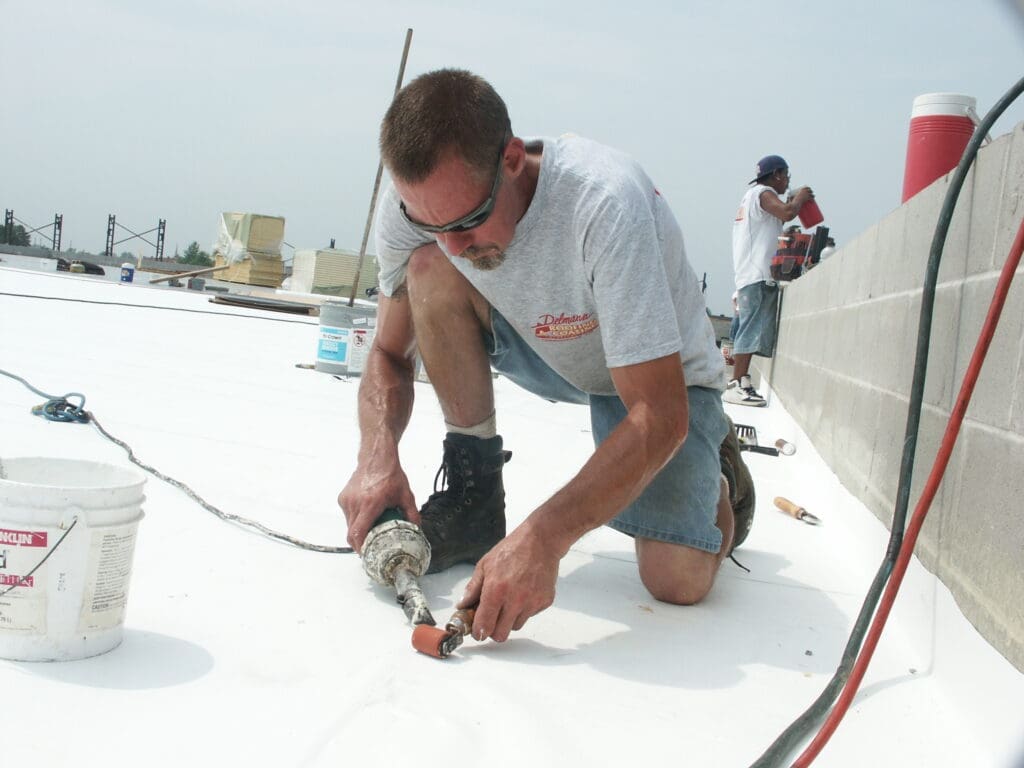
Single-ply roofing is a common answer. These factory-made membranes cover the roof in one layer and come in several materials:
- TPO (thermoplastic polyolefin), a heat-welded membrane
- PVC (polyvinyl chloride), a welded membrane
- EPDM (ethylene propylene diene monomer), a synthetic rubber membrane
Some buildings call for a different approach. We also work with membrane roof coating for EPDM and TPO, metal roof restoration, fabric-reinforced roofing, and foam and coating roof systems. Matching the system to the property, rather than defaulting to one product, separates a durable roof from a short-lived one.
The Skilled Labor Behind a Sound Roof
Good materials still depend on trained hands. The U.S. Bureau of Labor Statistics reports that roofers held about 166,900 jobs in 2025, and it projects 5 percent employment growth from 2025 to 2035. The agency also notes that roofers work outdoors in extreme temperatures at physically demanding tasks.
Safety shapes that work as well. OSHA sets its fall protection threshold at six feet in the construction industry. For Fillmore property managers, these facts make training and safe practices fair topics for any bid.
That brings us to the questions worth asking before you hire.

Questions to Ask Before You Hire a Commercial Roofer
A clear checklist helps you compare proposals fairly. Start with these:
- Which roof system fits my building, and why?
- How will you handle drainage, seams, and flashings on a low-slope roof?
- How does the project meet the current Uniform Code and Energy Code?
- What roof inspection and roof maintenance schedule do you recommend after installation?
- Can you share proof of insurance?
We welcome every one of these questions. We are happy to provide proof of insurance on request. You can also see our past projects in our photo gallery or read what customers say on our reviews page.
Talk With Our Fillmore Commercial Roofing Team
Industry standards only help when they are applied carefully to your building, so it is worth asking any contractor how they approach installation and detailing. At Genesee Valley Roofing, we work exclusively on commercial properties from our office at 8308 Ballard Rd in Fillmore. Our Fillmore, NY commercial roofing team serves Western New York and the surrounding areas with roof repair and the services above.
If storm damage affects your roof, ask us about roof storm damage repair. Whether you manage a warehouse, a storefront, or an industrial facility, we can walk through these questions with you. If you want a clear picture of your roof’s condition, reach out to our Fillmore team and we will help you plan your next step.


